
Mercer Parole and Probation
Illinois assigns these cases to different systems. The Illinois Department of Corrections Parole Division supervises people who leave an IDOC institution on parole or mandatory supervised release, often shortened to MSR. The Illinois Prisoner Review Board sets or reviews release conditions and handles the hearings within its statutory authority. Mercer County Probation and Court Services belongs to the local court system. It supervises people whom a judge places on probation or related community supervision.
Probation is a court sentence served in the community under stated terms. It does not prove that the person served an IDOC prison term. Parole or MSR follows release from a state prison while part of the sentence remains under supervision. Neither status means the criminal case vanished. The Mercer court docket, the sentencing order, and an IDOC profile answer different parts of the question.
| Point | Parole or MSR | Probation |
|---|---|---|
| Source | Release from IDOC custody | Mercer court sentence |
| Supervisor | IDOC Parole Division | Mercer County Probation and Court Services |
| Public starting record | IDOC profile | Judici case docket and sentencing order |
| End point | Final discharge or other official termination | Court-recorded completion, discharge, or termination |
- Mandatory supervised release
- A period of state supervision after prison release, shown in some systems as parole.
- Discharge
- The official end of a sentence or supervision, not merely the day a person left a facility.
- Absconder
- A person alleged to have stopped reporting or left supervision without approval.
- Detainer
- A request or legal hold that can prevent community release or lead to transfer.
Check Mercer Post-Release Supervision
Begin with the custody path, not a guess based on the charge. A Mercer jail departure can lead to the community, IDOC, another county, or federal custody. The Mercer County released-inmate search and records path explains how to establish that first movement. Once a state-prison history or local probation sentence is known, use the matching route.
- Match identity. Use full name, date of birth when available, case number, or IDOC number. Similar names are not enough.
- Check IDOC for state supervision. Open the IDOC Individual in Custody Search. Read Offender Status, Parole Date, parole district, and Projected Discharge Date when shown.
- Check the Mercer case for probation. Search the Mercer County Judici portal, preferably by case number. Read the judgment and later docket entries.
- Ask the correct office. Use IDOC/Parole for a state case or Mercer Probation and Court Services for a local court sentence. Offices may withhold schedules, addresses, safety information, or third-party details.
- Record the source and date. State whether the record showed parole, MSR, probation, a warrant, or final discharge. Do not replace the official term with “free.”
An IDOC Parole Date is the prison-release event. A Projected Discharge Date concerns the expected end of the sentence and supervision, and can change.
Mercer Supervision Office Records
Mercer County Probation and Court Services is listed in the Mercer County Courthouse at 100 SE Third Street, Aledo. The county probation page lists 309-582-5169 and office hours of 8:00 a.m. to 4:00 p.m. Monday through Friday. A caller should provide the case number and ask which public record confirms the sentence or supervision status, rather than seeking a private reporting schedule.
Mercer County Probation and Court Services
Mercer County Courthouse
100 SE Third Street
Aledo, IL 61231
Phone: 309-582-5169
Hours: Monday-Friday, 8:00 a.m.-4:00 p.m.
The Circuit Clerk maintains the court record. Its office is on the courthouse third floor, at the same street address, with mail to P.O. Box 175, Aledo, IL 61231. The listed phone is 309-582-7122, option 2. For state cases, IDOC's main custody-information numbers are 217-558-2200 and 1-888-446-9103. The public profile should be checked before calling so the correct IDOC number and status fields are at hand.
Illinois Parole Hearing Records
A parole hearing is not a routine step for every modern IDOC sentence. Illinois largely moved from discretionary parole to determinate sentencing for offenses after February 1, 1978. The Prisoner Review Board still handles legacy indeterminate cases, MSR conditions and revocation, early final discharge, and specific statutory forms of review. Modern IDOC profiles commonly use Projected Parole Date for anticipated release to MSR. That field does not prove a board granted discretionary parole.
The PRB operations and hearing hub says hearings occur by video and monthly dockets are prepared through institution liaisons. Prospective schedules can change. Published results describe completed board action and must be read in their own terms.
The official current en banc results show how the Board reports decisions.
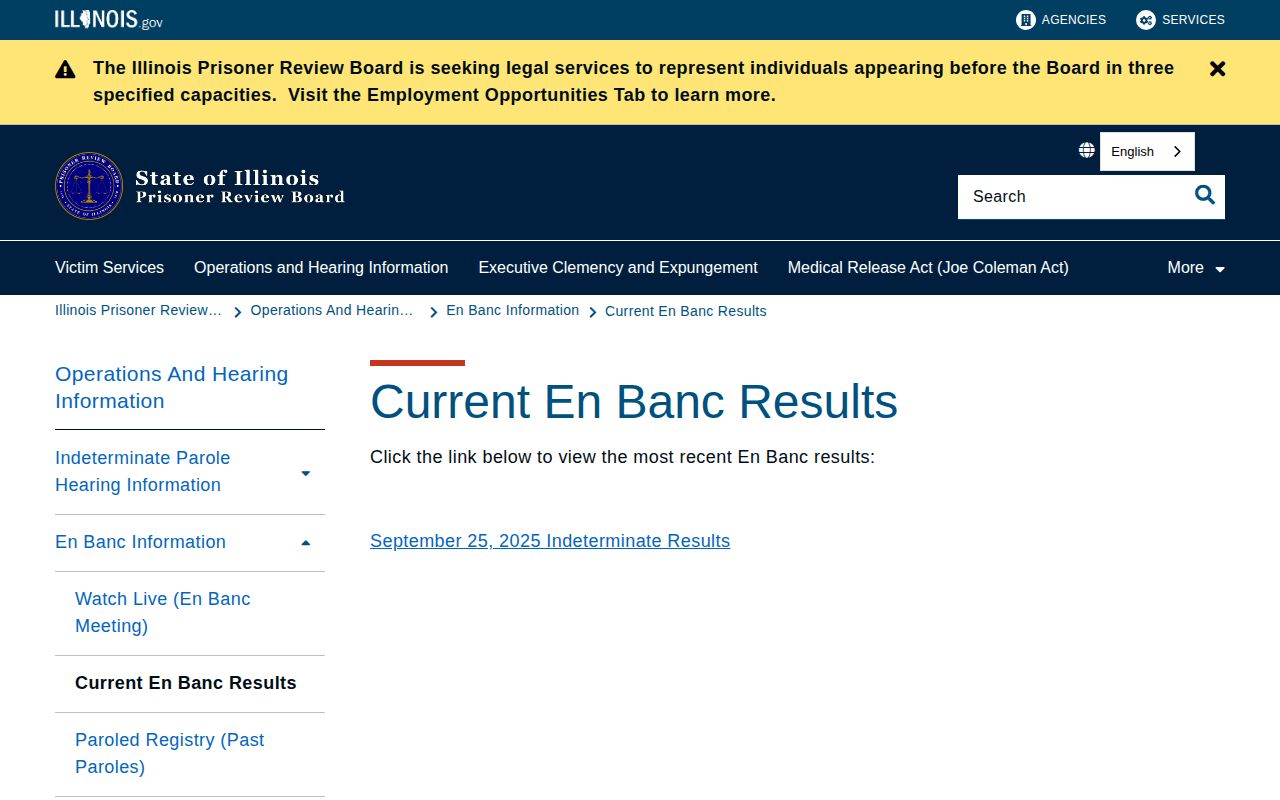
The capture is a decision source, not a Mercer County roster. Match any entry to the person and case through official identifiers before drawing a conclusion.
Legacy indeterminate cases generally involve crimes from before Illinois's February 1978 transition. IDOC calculates the minimum term, and the en banc Board may grant or deny parole after eligibility. A denial can establish a later hearing date. Some modern youthful-offender provisions also allow review after statutory periods, but age, offense, sentence, and offense date control. Those limited routes should be checked against the governing statute rather than reduced to one eligibility fraction.
Revocation proceedings use separate schedules and published results. They address an alleged breach after prison release and can result in continued supervision or a return to custody under the governing process. Early final discharge is different again because it concerns ending parole or MSR before the projected discharge date. A hearing calendar, a decision result, and an IDOC custody profile each answer a distinct question.
Mercer Supervision Violations
Conditions may include reporting, travel limits, treatment, payment obligations, no-contact terms, or other case-specific duties. The controlling order or supervision document matters. A violation allegation can trigger a petition, warrant, revocation process, or return to custody, but an allegation is not a new conviction. An “absconder,” fugitive, or wanted notation likewise reports an alleged failure or warrant status. It does not establish where the person is physically located.
For local probation, inspect the Mercer docket for a petition, warrant, hearing, or later order, then confirm with the issuing court channel. For state supervision, use the IDOC profile, IDOC Wanted Fugitives channel, and PRB revocation materials where applicable. The sheriff research found no separate public Mercer County probation-absconder list. A missing name from one list is never proof that no warrant exists.
VINE can give custody or case-event notice when the relevant agency participates, but it is not a supervision-office directory. An alert should be checked against the agency named in the event.
Financial obligations on a Mercer probation case have their own public path. The county probation instructions direct users to Judici, then Cases and Case Search, where the full four-digit-year case number opens the docket and its fines-and-fees entries. A displayed balance or due date does not disclose a private appointment schedule. Online payment can include a fee and may take several days to post, so the docket should be checked again before treating a payment as recorded.
Mercer Supervision Discharge
Physical release, supervision, and final discharge form a sequence: prison custody → parole or MSR → final discharge. Probation follows a different route: court sentence → county supervision → court-recorded completion or termination. A person may be outside a jail or prison while still bound by an active sentence. That is why a release date alone cannot prove that all obligations ended.
IDOC says its live search generally covers people who are incarcerated or on parole. After full discharge, a former person's profile may no longer appear. Use IDOC's Contact Us route and select Record Search for older releasable admission, release, status, and sentencing facts. Supply the full name, birth date, approximate admission year, institution, conviction county, and known dates. A narrow “no public result found” statement is more accurate than claiming no state record exists.
Early final discharge is a separate PRB process. The Board may consider compliance, risk and needs, treatment or programming, case facts, victim input, safety, and an IDOC recommendation. The official decision, not an estimated calendar calculation, establishes an early end. For probation, obtain the relevant Mercer order or docket entry. If the online docket is unclear, request a plain or certified copy from the Circuit Clerk and ask for the current fee.
Keep the end dates distinct when recording the result. The IDOC Parole Date marks release from prison, while Projected Discharge Date anticipates the end of the state sentence and supervision. A Mercer probation closing entry comes from the court instead. These records can describe the same person at different stages without conflicting.