
Mercer Projected and Actual Release Dates
A projected date is a current calculation based on the sentence, qualifying credit, legal rules, and information then held by the custodian. The actual release is the event recorded after the agency resolves identity, court orders, warrants, detainers, transfers, and ordinary discharge processing. The two dates may match, but they answer different questions.
A pretrial Mercer County detainee has no sentence-completion date to calculate. Illinois has used statewide nonmonetary pretrial release since September 18, 2023, and the judge's detention or release order controls the legal path. Even a “time served” entry does not guarantee immediate community release if another case, warrant, detainer, identity issue, or receiving agency remains unresolved.
How to Find a Mercer Release Date
Choose the route by custody, not simply by where the person was last seen. Mercer County Jail, IDOC, and federal systems keep different records.
- Open the Mercer case on Judici and identify whether the person is pretrial, serving a county term, or committed to IDOC.
- For a fixed county-jail sentence, call Mercer County Jail at 309-582-5020 and ask for the calculated release date and any recorded hold.
- For a state prison sentence, search the IDOC Individual in Custody Search using the IDOC number when possible.
- Read Projected Parole Date, Last Paroled Date, Projected Discharge Date, status, and Parent Institution together.
- If the person is absent after full discharge, use IDOC Record Search with name, date of birth, conviction county, and date ranges.
- Near the expected date, confirm the event with the agency that has custody and check for a transfer rather than assuming release to the community.
The Mercer County released-inmate guide explains the broader court and sheriff record chain when the inquiry is about a completed event instead of a future date.
IDOC Fields for Mercer Prison Sentences
IDOC's search result separates prison release, supervision, and sentence completion. Those fields should never be collapsed into one “release date.”
| IDOC field | Meaning for a Mercer case |
|---|---|
| Admission Date | Shows when the person entered IDOC, not when Mercer jail custody ended. |
| Status | May read IN CUSTODY, PAROLE, or ABSCONDER and frames every date below it. |
| Parent Institution | Identifies the responsible IDOC institution or parole district. |
| Projected Parole Date | Current anticipated date for release from prison to mandatory supervised release. |
| Last Paroled Date | Shows a recorded prior transition from the institution to supervision. |
| Projected Discharge Date | Expected end of the sentence and supervision, not the prison exit date. |
The official IDOC projected-parole result format illustrates how the date appears with the rest of the record.
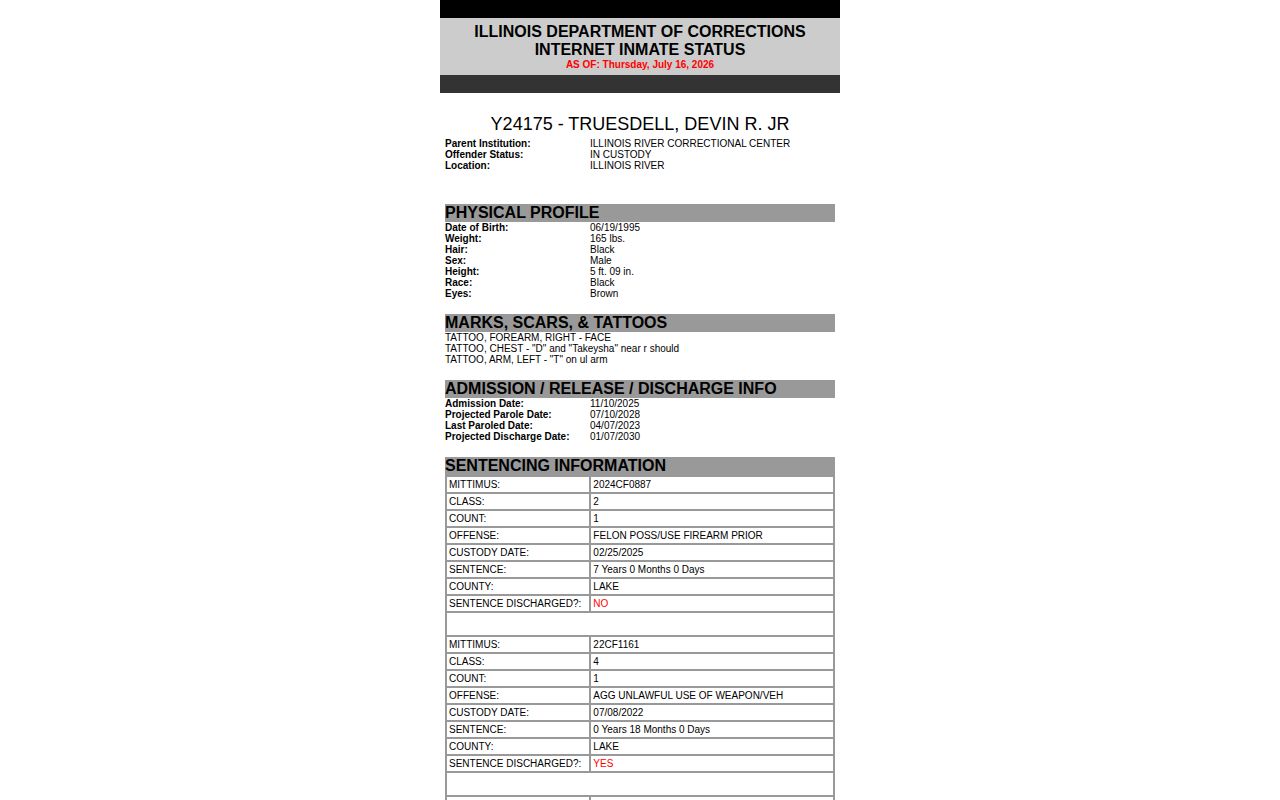
The status and institution fields beside the date prevent a future projection from being misread as an already completed release.
Mercer County and IDOC Credit Rules
Mercer county sentences and IDOC sentences do not use one shared good-time formula. This distinction is the central Illinois release-date computation issue for Mercer County.
An eligible fixed county-jail term falls under 730 ILCS 130/3. County good-behavior credit is not an IDOC award, and exclusions can turn on the offense, sentence type, presentence credit, periodic imprisonment, physical harm, mandatory minimums, impact incarceration, or specified sex offenses. The proper county calculation starts with the court's sentence, adds the legally recognized custody credit, applies only qualifying county credit, checks other holds, and then allows for physical processing.
A state prison date is governed through 730 ILCS 5/3-6-3 and offense-date-specific rules. Illinois cannot be reduced to the claim that every person “serves half.” For many offenses outside enumerated exceptions, one day of credit for each day served can create a potential 50-percent framework. Certain truth-in-sentencing offenses limit credit to 4.5 days per month, or about 85 percent served. Certain enumerated drug offenses use 7.5 days per month, or about 75 percent. Some first-degree murder categories can require 100 percent.
IDOC Earned Sentence Credit Is Discretionary
IDOC describes Earned Sentence Credit as an award of up to 180 days for qualifying people, not an automatic amount that a family can add to a calendar. IDOC considers time in custody, statutory exclusions, risk and needs, the crime circumstances, forcible-felony history, discipline, rehabilitation or program work, and treatment.
If an award changes the projected parole date, IDOC says the public profile is adjusted and the individual is notified. Until that occurs, an anticipated award should not be reported as earned. Program participation at Mercer County Jail also should not be treated as IDOC sentence credit. The 2024 jail inspection names local detention programs, but it does not establish an automatic post-sentence reduction.
What Can Change a Mercer Release Date
A date may move because the legal or custody inputs changed. The reason matters more than the direction of the change.
| Factor | Possible effect |
|---|---|
| Sentence credit | A lawful award or corrected credit calculation can move a projected date. |
| Discipline | Loss or restoration of eligible credit can alter IDOC timing. |
| Court order | Resentencing, correction, or a pretrial ruling can change the controlling basis. |
| Warrant or detainer | The current custodian may release the person to another agency instead of the community. |
| IDOC parole or MSR action | A projected institutional exit may lead to supervision, while a revocation may return the person to custody. |
| Earned Sentence Credit | A discretionary IDOC award can update projected parole timing after approval. |
| Processing and identity checks | The court's legal date and the sheriff's physical discharge timestamp may differ. |
A transfer from the Aledo jail to IDOC, another county, or USMS closes one local custody event but does not establish community release. Ask for the receiving agency whenever a final movement is unclear.
Parole Date Is Not Final Discharge
Modern Illinois determinate sentences commonly lead from prison to mandatory supervised release, often labeled parole in public interfaces. The IDOC Projected Parole Date anticipates the institutional exit. Projected Discharge Date anticipates the end of sentence and supervision. A person can therefore be released from prison while remaining under IDOC supervision.
The Illinois Prisoner Review Board has a separate Early Final Discharge process. The Board may consider risk and needs, victim input, compliance, treatment or programming, case facts, safety, and an IDOC recommendation. It should not be assumed from time spent successfully in the community. Probation is different again: Mercer County Probation and Court Services supervises court-ordered probation, not an IDOC prison release.
Legacy indeterminate and certain youthful parole cases have specialized PRB eligibility paths. For many pre-February 1978 crimes, IDOC calculates minimum time and the Board may grant or deny parole at recurring hearings. Modern youthful-parole review under 730 ILCS 5/5-4.5-115 depends on age, offense, sentence, and offense date. These paths require the governing statute and actual case record, not a universal estimate.
Federal Dates for People Held in Aledo
Mercer County Jail houses some federal prisoners in transit or awaiting trial. A USMS movement can remove a person from Mercer custody while federal custody continues. A federal pretrial defendant may not appear in BOP's sentenced-prisoner locator, so the federal court order and USMS or facility confirmation are the better sources.
For a sentenced federal person, BOP results display Release Date and Location. Read both. A future date for a current prisoner is different from “Released” or “Not in BOP Custody,” and even those statuses establish only the end of BOP custody. Supervised release or another custodian may follow. First Step Act recalculation can also change a projected federal date.
Confirm a Mercer Release Date
Near the expected date, use the agency that owns the record. Mercer County Jail can confirm its calculated county date, holds, and final movement. A written sheriff request can seek the discharge or transfer timestamp and receiving agency. IDOC controls the state prison profile and historic Record Search. The court docket supplies the judgment and later orders but does not replace the physical release entry.
A written Mercer sheriff request need not use a special form. It may be sent to mcso@frontiernet.net, faxed to 309-582-5158, or mailed or delivered to the Office of Sheriff, 906 SW Third Street, Aledo, Illinois 61231. Identify the person, booking or case number if known, custody date range, and exact record sought. Ask for the calculated date, actual discharge or transfer time, release type, and receiving agency. The sheriff processes only records it holds and may not forward a request sent to the wrong custodian.
Illinois FOIA section 2.15, 5 ILCS 140/2.15, supports a focused request for the time and date a person was received into, discharged from, or transferred from agency custody. Its no-later-than-72-hours rule applies to furnishing specified arrest-report information after arrest. It is not a rolling release list and does not promise that a future release calculation will be available on that timetable.
If a projected date passes with no confirmed release, ask whether IDOC updated sentence credit, a court entered a later order, discipline affected credit, or another agency placed a hold. For a person leaving Mercer County Jail, ask whether staff recorded community discharge, IDOC transfer, another-county transfer, or USMS transfer. Each outcome can end Mercer custody on the expected day while producing a different legal status.
Illinois VINE can provide a pending status alert through phone, email, text, or app. The Mercer VINE inmate check explains registration and the four-digit telephone PIN. Treat the alert as a prompt to verify, especially if it reports a transfer. A delayed or missing alert does not override the agency record.
For historic IDOC information after a person disappears from the live search, use Record Search rather than treating the blank result as proof that no state sentence existed. Provide the full name and date of birth, include Mercer as the conviction county when accurate, and narrow the likely admission and release years. That history is more durable than a screenshot of a once-projected date.
Source checks for this guide were reviewed in July 2026. When reporting a result, use precise language such as “projected parole,” “projected discharge,” “Mercer transfer,” or “sheriff-recorded discharge.” Precision keeps a forecast from becoming a false claim about actual release.
Public Record Search
Sponsored Results